How the Browser Shooter Grew Up From Flash Portals to WebGL Arenas
If you were online in the mid-2000s, you probably remember the ritual: open a game portal, wait for the loading bar, click "allow" on some plugin warning, and then squint at a shooter running in a window about the size of a postcard. Half the fun was that it worked at all. These days a browser shooter can drop you into a live match with strangers from three continents before a desktop launcher has even finished checking for updates. Getting here took a long, slightly messy decade of trial and error.
When Shooter Games on Browser Tabs Meant Installing a Plugin
Action games were never part of the web's original plan. Java applets and Shockwave got there first, clunky as they were, and then Flash took over and sites like Newgrounds and Miniclip filled up with things like Boxhead and the early Alien Hominid. When Adobe finally pulled the plug on Flash at the end of 2020, a huge chunk of the web had to be rebuilt on open standards — and not just games. Online casinos went through the same scramble, porting their slots and card tables to HTML5, which is why something like playzini casino now loads in a regular tab the way an arcade shooter does.
Honestly, the forced move did the genre a favor. HTML5 canvas meant developers could draw straight into the page without asking anyone to install anything. WebGL showed up in 2011 and gave them a proper line to the graphics card, and WebSocket (standardized that same year) finally made fast back-and-forth with a server practical instead of hacky. Put together, they turned shooter games online in the browser from a school-lab curiosity into something people took seriously.
| Era | Core technology | Typical shooter | Main headache |
|---|---|---|---|
| Late 1990s–early 2000s | Java applets, Shockwave | Basic arcade clones on one screen | Slow loads, scary security pop-ups |
| Mid-2000s–2010s | Adobe Flash | Side-scrollers, zombie survival, turret games | Crashes, almost no real multiplayer |
| 2011 onward | HTML5 canvas, WebGL | Smoother 2D, the first 3D attempts | Every browser behaved a bit differently |
| 2015 onward | WebSockets, .io servers | Huge top-down arenas | Server bills, lag spikes at peak hours |
| Now | WebGL 2, WebAssembly, WebGPU | Proper 3D first-person maps | Old laptops and cheap phones struggle |
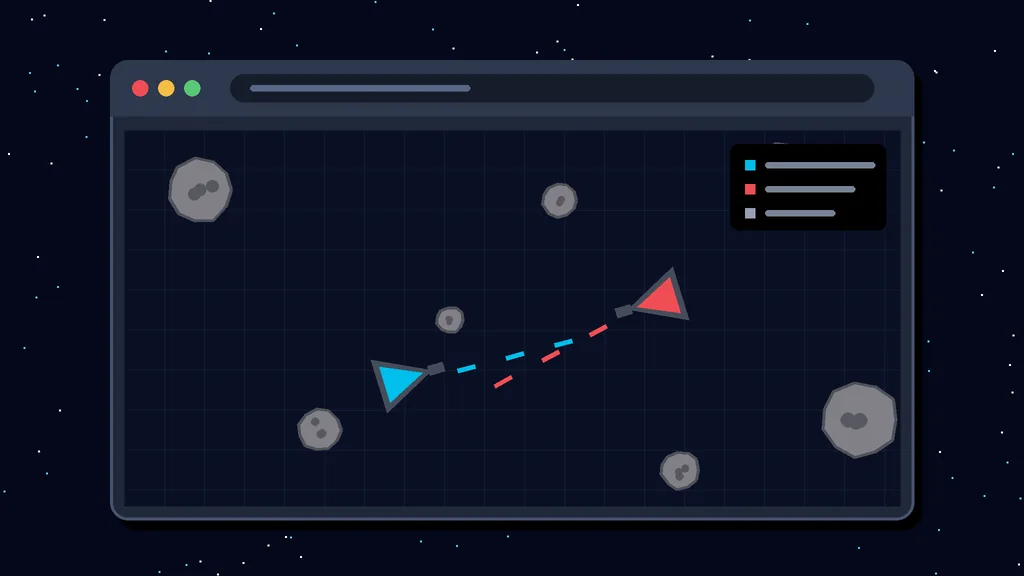
The Quiet Engineering Behind a Fair Browser Based Shooter
Visuals get the screenshots, but fairness comes down to networking, and most of that work is invisible. Every time you fire, that shot has to travel to a server, get checked against where everyone else was standing, and come back with a verdict — hit or miss. If a game simply sat there waiting for the answer, your ship would feel like it was wading through wet sand.
The usual toolbox looks something like this:
- Client-side prediction, so your own ship moves the moment you press a key
- Server reconciliation, which nudges you back into place if the guess was off
- Interpolation, so other players glide instead of teleporting around
- Lag compensation, meaning a hit counts based on what you saw on your screen
- A server that has the final say, which shuts down the laziest cheats
- Servers in several regions, so the signal doesn't cross an ocean
- Tiny updates that only send what actually changed
The browser adds its own limits, too. The game lives in a sandbox, fights other open tabs for memory, and has no idea whether it's running on a gaming PC or a five-year-old school Chromebook. Good teams just design around it.
"Nobody notices good netcode. You only notice it when it breaks — when your shot clearly connected and the other ship just keeps flying."
Top-Down Arenas, First-Person Maps, and Everything Between
The genre is wider than most people picture. Agar.io blew up in 2015 and kicked off the whole .io wave — giant shared arenas, two or three controls, instant respawns. Diep.io turned the idea into tank combat a year later, and space shooters copied it too. Then Shell Shockers and Krunker came along and proved, a bit to everyone's surprise, that twitchy first-person aiming could run fine in a tab as well.
Each style wants something a little different from you, and from your hardware. Mostly it comes down to mood and free time.
| Style | Camera | How a round feels | Good pick for |
|---|---|---|---|
| Top-down .io arena | Overhead | Messy, you're back in seconds | Coffee breaks, friendly grudges |
| Browser first-person shooter | First-person | Tense, all about aim | People coming from console or PC shooters |
| Side-scrolling run-and-gun | Side view | Learn the patterns, beat the level | Flash-era nostalgia |
| Vertical bullet hell | Overhead, scrolling | Frantic, heavy on memory | When you want to really focus |
| Turn-based artillery | Side view | Slow and sneaky | Lazy evenings with friends |
For most people, the overhead arena is still the easiest door in. You can see the whole fight at once, and dying costs you a few seconds, not a ten-minute match.
What Players Actually Notice in a Shooter Browser Game
Regular players almost never talk about shaders or frame budgets. They talk about feel — does the ship react the instant you press the key, or is there that tiny, maddening delay? Does it load while you're still curious, or do you wander off to another tab before it's ready?
Take away the technical talk and the wish list is surprisingly short:
- Controls with zero noticeable delay
- Being able to read the danger even when the screen is chaos
- Quick loading, no sign-up wall
- Servers that fill up fast so you're not waiting alone
- Getting stronger by playing well, not by paying
- Running smoothly on an ordinary laptop
That's why scrappy little games often outlast flashy ones. If the hit detection is honest and you can always tell what's going on, people trust it, and once they trust it, a one-off visit quietly turns into a habit.
"You can get away with plain graphics for years. You can't get away with one missed shot that should have landed."
Instant Play Beyond Gaming and Where the Format Goes Next
Shooters weren't the only thing to move into the tab. Video, documents, design software, casino lobbies — almost everything now promises one click and you're in. Shooters just got there early, mostly because their players were the least patient people on the internet.
What's next looks exciting. WebGPU should allow better lighting and much bigger battles without a separate download, and WebAssembly is letting studios bring over engines that used to be strictly desktop territory. Still, I doubt the core of the thing will change much: a good browser shooter respects your time, gives everyone a fair shot, and makes "one more round" very easy to say.
Looking back, the whole story is really about people running out of patience and technology finally catching up with them. Those plugin experiments on crowded portals turned into a genre with real depth, clever netcode, and room for everything from chaotic arenas to tense first-person maps. You don't need an expensive rig or a free afternoon. A spare tab, ten minutes and a bit of curiosity will do.