What Makes a Space Combat Simulation Game Feel Real
Aim at the bad guy, hold the trigger, watch him pop. That's space combat the arcade way, and there's nothing wrong with it. A space combat simulation game wants more from you, though. All of a sudden you're thinking about momentum, shuffling power between shields and guns, and asking yourself how on earth you just sailed straight past the ship you were chasing. The first few hours can feel a bit like homework. Then something clicks — and it stops feeling like a game about flying and starts feeling like flying.
So much online entertainment is designed to be instant: a quick browser shooter, a few spins at an online casino like spinanzia, one more short video before bed. A real sim goes the other way. It wants a whole evening, a fair bit of patience, and quite possibly a keybinding chart taped to the edge of your desk. For a certain kind of player, that's the entire point.
Somewhere Between Arcade and Physics Homework
Think of space combat games as a long slider. Way over on one side is pure arcade — ships whip around instantly and stop dead the moment you let go. On the far side, ships act like actual objects in a vacuum, where stopping takes just as much effort as getting going. Most games land somewhere in between.
The history moves along that slider too, more or less. Elite (1984) squeezed wireframe ships onto home computers. Wing Commander arrived in 1990 with movie-style missions. X-Wing (1993) handed players a little power panel for engines, lasers and shields — and people loved fiddling with it mid-fight. Then came FreeSpace 2 in 1999, which fans still bring up whenever someone asks for the best of that era.
| Approach | How ships move | What you're managing | Example |
|---|---|---|---|
| Arcade | Turn on a dime, stop on a dime | Aim and dodging | Most browser space shooters |
| Cinematic sim | Like a fighter plane, a bit of drift | Power, targets, wingmen | Wing Commander, X-Wing, FreeSpace 2 |
| Newtonian sim | Full momentum, thrusters pointing everywhere | Speed, facing, fuel | Independence War |
| Hard sci-fi | Real orbits, huge distances | Orbits, range, heat | Children of a Dead Earth |
| Fleet tactics | You give orders, others fly | Positioning, sensors, timing | Homeworld, Nebulous: Fleet Command |
Energy, Momentum, and the Art of Not Overshooting
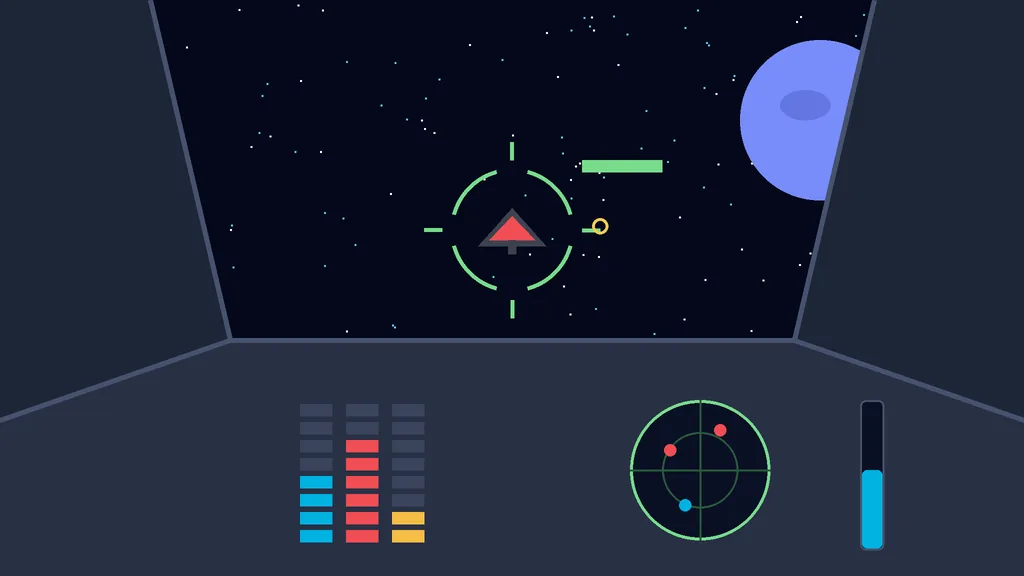
Momentum is what catches most new sim pilots off guard. Take Independence War (1997): spin your ship around and it keeps drifting the way it was already going. That sounds annoying, and for about an hour it is. After that it opens up tricks an arcade game could never allow — like sliding backward while you shoot at whoever's on your tail.
Power is the other big headache. Plenty of sims give you a fixed pool of energy and make you decide where it goes. Pile it into shields and you survive longer; push it to weapons and fights end sooner; dump it into engines and you can get out of trouble. You never get all three at once, and the good pilots shift that balance several times in a single fight without really thinking about it.
In a decent sim you're usually keeping half an eye on:
- How fast you're going compared with where your nose is pointing
- The split of power between shields, weapons and engines
- Which target is the real threat, not just the closest one
- Missile lock warnings, and the right moment for countermeasures
- What your wingmen are doing, and where they've wandered off to
- Fuel, ammo or heat, depending on the game
Yes, it's a lot at first. Give it a few hours and most of it slides into muscle memory.
"Arcade shooters are about reacting. Sims are about planning — and then reacting when the plan falls apart."
When a Space Combat Game Turns Into Chess
Pull the camera back far enough and you get the tactical space combat game, where you might never touch a joystick at all. Homeworld (1999) put you in charge of whole fleets moving in full 3D. FTL (2012) shrank things down to one fragile ship that you babysit room by room while it slowly falls apart. Nebulous: Fleet Command, meanwhile, builds its fights around sensors and missiles — and around working out where the enemy is before they work out where you are.
Same stars in the background, very different jobs:
| Game type | Who you are | Pace | What usually wins |
|---|---|---|---|
| Cockpit sim | The pilot | Real time, fast | Flying skill, awareness |
| Real-time fleet tactics | The admiral | Real time, slower | Positioning and timing |
| Pausable tactics | The captain | Stop, think, go | Getting priorities right |
| Turn-based tactics | The commander | One move at a time | Thinking several turns ahead |
What ties them together is that the sharpest player tends to beat the quickest one. Fast hands won't rescue a bad position.
Learning the Ropes With a Free Space Combat Game
Good news: finding out whether sims are your thing doesn't have to cost a cent. Volition released the FreeSpace 2 source code back in 2002, fans turned it into the FreeSpace Open engine, and complete fan-made games such as Diaspora and Wing Commander Saga came out for free on top of it. If that still sounds like a big jump, a browser arcade shooter is a softer landing. It trains your aim and your sense of space without the keyboard gymnastics.
A few habits that take the sting out of the learning curve:
- Start with something arcade or cinematic before going full physics
- Learn five or six controls properly and ignore the rest for now
- Sit through the tutorials, even the slow ones
- Fight easy AI until moving around feels natural
- Plug in a cheap joystick or gamepad if you've got one lying around
- Think back over your last few deaths and look for a pattern
Above all, go easy on yourself. Those first hours really are the hardest bit.
"Nobody's good at a space sim on day one. Every pilot you see flying beautifully once spent a whole evening crashing into the same asteroid."
Why People Keep Climbing Into Virtual Cockpits
There's something about a cockpit, even a pretend one, that other genres don't quite manage. The best sims make you feel like you're running a machine rather than steering a character around. Star Wars: Squadrons (2020) went as far as VR support, and plenty of fans have built little home setups with flight sticks and throttles bolted to the desk.
It's a niche, sure. It's also an unusually loyal one, because there's always another layer to learn.
A space combat simulation game isn't for everybody, and it doesn't have to be. It swaps instant thrills for something slower and deeper — that moment when you finally get how your ship moves and how a fight actually works. If that sounds like your kind of fun, grab a free one, learn a handful of controls, and give it more than a single evening. That first clean dogfight win will feel properly earned.