Why Space Became the Perfect Setting for Shooter Games
Ask almost anyone who grew up near a screen and they'll describe the same picture: a little ship, a lot of black, and a handful of bright shapes heading its way. The space shooter is one of the oldest ideas in video games, yet it still feels new whenever a decent one shows up. Nostalgia explains some of that. The rest comes down to space being a ridiculously good place to put a game — and the look has long since escaped gaming, turning up on movie posters, sneakers and the slot lobbies of online casinos like needforslots.
A Genre That Started on a University Mainframe
Nobody built the first space shooter to make money. In 1962 a small group at MIT wrote Spacewar! for a PDP-1, a machine roughly the size of a couple of refrigerators, and two players flew tiny ships around a star whose gravity kept dragging them in. Copies traveled from one university lab to the next, mostly because anyone who watched a round wanted a turn.
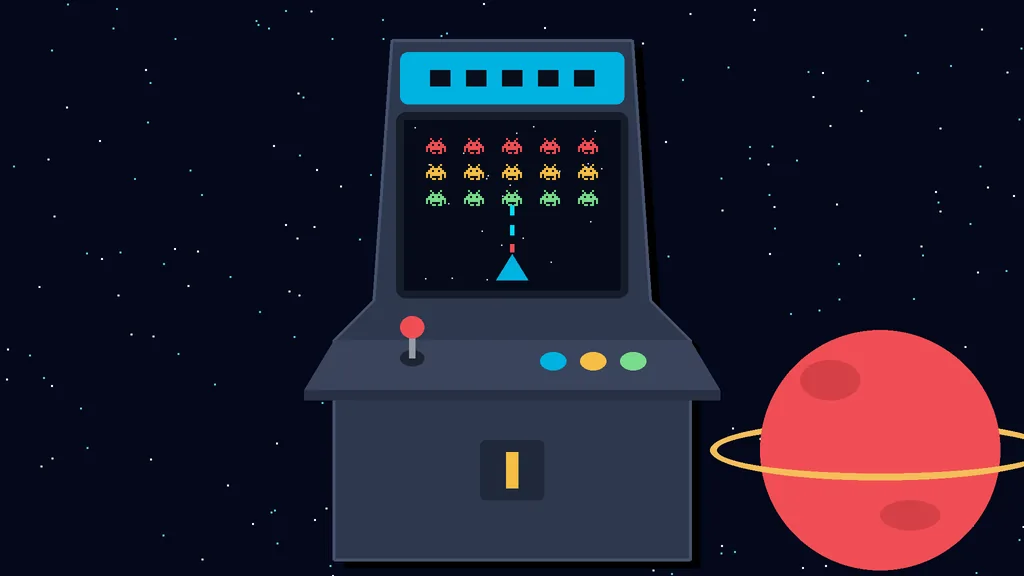
Arcades were what turned it into an industry. Taito's Space Invaders landed in 1978 — one cannon, a slowly marching wall of aliens, and a heartbeat soundtrack that sped up as they got closer. Atari answered in 1979 with Asteroids, where your ship kept drifting after you let go of thrust and the screen wrapped around at the edges. Then Namco's Galaga (1981) sent enemies swooping and diving, and could even kidnap your fighter with a tractor beam. Three games, four years, and most of the genre's vocabulary was already in place.
What an Empty Black Screen Does for Game Design
Designers keep picking space for reasons that are surprisingly practical. Against a dark background every bullet, enemy and pickup pops, which matters enormously once things get fast. There's no terrain to model and no walls to explain, and gravity only exists if somebody decides it should. If something's on screen, it's on screen for a reason.
| Design element | What it does for the player | Classic example | Where it lives on |
|---|---|---|---|
| Dark, empty background | Keeps every threat easy to spot | Space Invaders | Pretty much every space shooter since |
| Inertia and drift | Turns just moving into a skill | Asteroids | .io arenas, physics shooters |
| Screen wrap | Leaves no corner to hide in | Asteroids | Arcade revivals and retro remakes |
| Enemy formations | Turns waves into patterns you can learn | Galaga | Vertical scrollers, bullet hell |
| Targets that split | Every hit creates fresh danger | Asteroids | Spaceblast and arena games like it |
Beyond readability, the setting hands designers a few tricks that a forest or a city street can't really offer:
- Any direction can be "up," so flying in a full circle feels natural
- Silence can work as atmosphere instead of feeling like missing audio
- Scale is effortless to show — your speck of a ship next to something enormous
- Weapons can look like anything, since nobody expects real-world logic
- A level can change completely without a cutscene explaining why
- Players already know the rules from fifty-odd years of sci-fi films
Put all of that together and you get a setting that almost designs itself, at least at first. Making it feel good is a different job.
"In space, nothing on the screen needs an excuse. If it's there, it's either about to hurt you or about to help you."
From Fixed Cannons to Twin Sticks and the Many Shapes of Space Shooter Games
The label "space shooter" stretches further than people expect. In some games you're pinned to the bottom of the screen; in others you can fly wherever you want. Konami's Gradius (1985) and Irem's R-Type (1987) made the side-scrolling version legendary, while Geometry Wars on Xbox 360 in 2005 introduced twin-stick shooting to a lot of players who had never stepped into an arcade.
Stars in the background are about the only thing these styles really share. How they play is another matter.
| Style | How you move | What it really tests | Early landmark |
|---|---|---|---|
| Fixed shooter | Left and right along the bottom | Timing and aim | Space Invaders, Galaga |
| Multidirectional arena | Anywhere, with momentum | Where you choose to be | Asteroids |
| Vertical scroller | Up the screen through waves | Reading patterns | Xevious |
| Horizontal scroller | Left to right through stages | Memory and nerve | Gradius, R-Type |
| Twin-stick shooter | One stick to move, one to aim | Doing two things at once | Geometry Wars |
Browser arenas like the one on this site are closest to Asteroids in spirit: free movement, drifting rocks, and a crowd of other players making everything messier.
Picking Free Space Shooter Games Worth Your Evening
There are now far more free space shooter games than anybody could get through in a lifetime, and the quality is all over the place. Some are clearly made by people who love the genre. Others are basically ad machines in a spaceship costume. Ten minutes of play is usually enough to tell which is which.
The ones worth keeping tend to get a few things right:
- Movement with some weight to it, but never sluggish
- Bullets and enemies you can read in a split second
- Hit boxes that feel fair when things get tight
- Upgrades that change how you play, not just a number on a stat sheet
- Sound that actually tells you something — a warning, a pickup, a close call
- Runs short enough that "one more go" feels harmless
If a game hits most of those notes, bookmark it. If it doesn't, well, the next one really is a click away.
"A good space shooter makes you feel like the pilot, not a passenger. When you die, you should know exactly why."
The Pull of the Void Beyond Gaming
The space shooter has outlasted a lot of fads, and honestly that's not much of a mystery. Space is the backdrop to so many stories people already love, from pulpy paperbacks to big summer films. It feels mysterious enough to be exciting and empty enough to hold almost any idea, which is why the same imagery keeps showing up in fashion, music videos and casino reels.
That familiarity is a real advantage for space shooter games online. Nobody needs a tutorial on what a laser does, or why a spinning rock heading your way is bad news.
From a mainframe experiment in 1962 to space shooter games you can open in a browser tab during lunch, the genre has stayed remarkably close to its roots. A small ship, a dark sky and something coming at you is still plenty. Designers return to it because it works, and players keep coming back because it never pretends to be anything else. So strap in, mind your drift, and see how long you can last.